
How to run a Giving Day
An in-depth, practical guide to planning and running a successful Giving Day, covering targets, storytelling, match funding and challenge mechanics, major gifts, the live 36 hours and stewardship, with real results from schools and universities.
A Giving Day is an intensive, time-bound online fundraising campaign, usually run over 24 to 36 hours, that asks your whole community to give within a single shared window. It is designed to do several jobs at once: bring in new donors, win back lapsed supporters, prompt fresh gifts from people who already give, and give your leadership and major donors a focal point to rally behind. Run well, a Giving Day compresses a year's worth of energy and goodwill into a day or two and leaves you with a larger, warmer donor base than you started with.
This guide reflects how Hubbub's consultants actually plan and run these campaigns. Since 2018 the team has delivered more than 200 Giving Days, drawing on over 25 years of fundraising experience across the education and charity sectors. The advice below is detailed on purpose, because the difference between a flat Giving Day and an exceptional one is rarely a single big idea. It is the accumulation of dozens of small decisions about data, message, timing and follow-up.
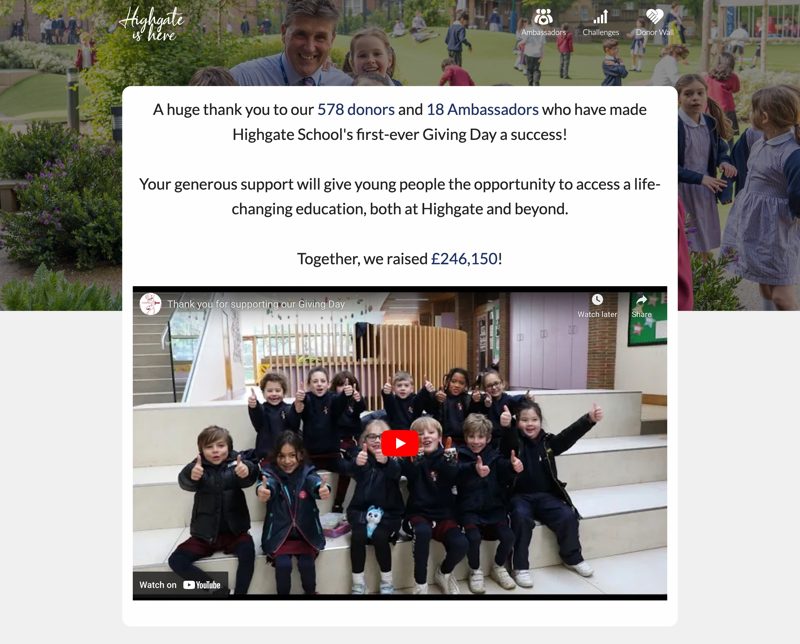
It helps to be honest from the start about the effort involved. Joe Connor, Fundraising Relationships Manager at Highgate School, whose Giving Day raised £250,981 from 578 donors, describes it plainly:
"Giving Days are hard work to plan, and your team will be extremely busy in the build-up and during the 36 hours of the day itself, but they are a unique opportunity to get everybody in your institution having fun and pulling together to do something good."
It is also a campaign you grow into rather than perfect on the first attempt. London Business School, who have now raised £1.18 million across four Giving Days from 2,445 donors, are open about the learning curve. Their first one was, in their words, "a very manual process," and they "underestimated the planning and workload involved." Their advice is to "take the leap if it fits into your strategy: you don't need to do everything in the first year." This guide will help you concentrate on the things that move the needle and leave the refinements for future rounds.
Working templates. Rather than starting from a blank page, sign in to download our project plan, communications plan, email copy templates and case for support template.
What a Giving Day is for, and where it fits
Be clear about why you are running one before you do anything else. Most institutions use a Giving Day as an annual moment to acquire new donors and reactivate lapsed ones, to prompt fresh gifts from existing supporters, and to put their leadership, major and legacy donors to work providing the match and challenge funds that motivate everyone else. It grows participation, the number of people who give, at least as much as it grows the total raised. Both matter, but a wider donor base is the asset you will steward and re-solicit for years, so participation is usually the metric to anchor on.
The campaign works best when it sits inside a continuous giving programme rather than standing alone. The Giving Day is the spark; the acquisition, reactivation and stewardship around it through the year are what turn that spark into a culture of giving. Treated as an annual fixture that feeds a regular giving programme, it compounds: each year's new and reactivated donors become next year's early givers and ambassadors.
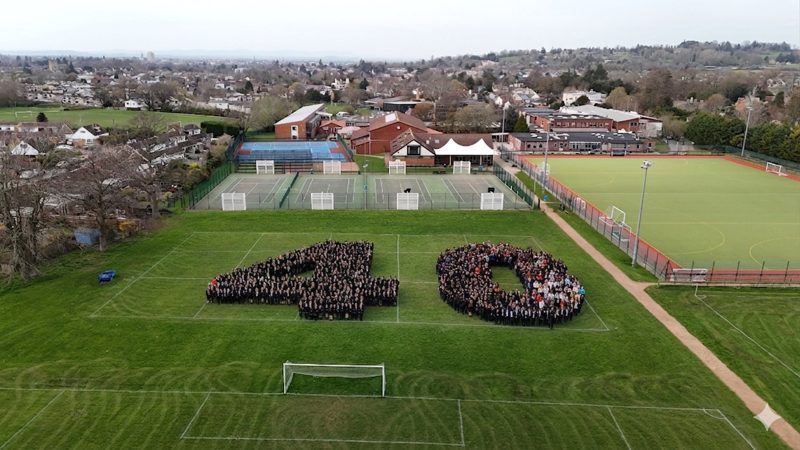
This is achievable for organisations of every size and type, not only large, well-resourced development offices. When Balcarras, a state school, ran its first Giving Day, it raised £40,101 from 219 donors, with gifts ranging from £1 to £2,000. Headteacher Dominic Burke is candid about why it now matters so much:
"Our recent Giving Day raised over £40,000 to fund a variety of projects in the school. State school funding is simply no longer adequate, particularly when it comes to capital projects, so fundraising like this is becoming vital to ensuring the long-term success of the school."
Data and target-setting
Everything starts with your data, and the single most important figure is how many of your contacts have a usable, deliverable email address. Email drives roughly 90 to 95 per cent of donations on a Giving Day, so your email-reachable audience is effectively the ceiling on what is possible. Spend real time here before you set any target: deduplicate your records, verify email deliverability, suppress hard bounces, and check that consent and contact preferences are clean, so that you can actually mail the people you are counting on.
Then segment. At a minimum, separate current donors, lapsed donors and non-donors, and within those distinguish your warmer and colder groups. Knowing the size and warmth of each segment lets you forecast realistically and tailor your asks, because a recent regular donor and a never-given alum who graduated twenty years ago need very different messages.
Set the target around participation first. A credible donor goal grows out of the size of your contactable audience, the number of emails you can responsibly send, your historic response rates by segment, your donors' giving history, and sensible peer benchmarks. Treat benchmarks with care: understand how a peer achieved a result, including their audience size and match funding, before you borrow their number. Income targets are still worth setting as internal KPIs, but lead with participation. To pressure-test your assumptions, model the likely outcome with Hubbub's Giving Day Simulator, and use external benchmarking such as CASE's Voluntary Support of Education to sense-check what good looks like for an organisation like yours.
A useful discipline is to work the target both ways. Build it bottom-up from your segments and expected response rates to see what the data supports, then sketch it top-down from the income you would like to raise and the match funding you can secure, and reconcile the two. If the numbers are far apart, the gap usually lies in either the size of your contactable audience or the amount of match funding in place, and both are addressable months ahead with list-building and major-donor conversations.
Building the team around it
You do not need a large team to run a strong Giving Day. You need the right people focused on the two things that determine the result: your email communications and your match and challenge funding. A typical core team has a Director of Development holding strategy and vision, a Fundraising or Regular Giving Manager running the project day to day, major gift fundraisers securing the match and challenge funds, and a communications lead writing and scheduling content. In a small shop, one or two people cover several of these roles, and that is fine provided the email programme and the match funding both have a clear owner.
The campaigns that outperform are the ones that pull in colleagues beyond the development office. Alumni relations can recruit ambassadors and help with stewardship; donor relations can carry the thank-you and impact communications; marketing can promote the day through institutional channels such as the website, social accounts and newsletters; faculty, staff and students provide both the buy-in and the on-campus moments that make a digital campaign feel tangible. Above all, secure genuine senior support early, ideally from the head of the institution. That is what turns a Giving Day into something the whole organisation rallies behind rather than a project the development team carries alone.
The six-month run-up
The best Giving Days are assembled steadily over roughly six months, not improvised in a frantic final fortnight. Our project plan template sets this out with tasks, owners and dates, but it helps to understand the arc of the work.
Six months out: strategy
Six months ahead, the work is strategic. Secure senior buy-in, lock in your dates including the pre-launch and live windows, and agree your income and donor KPIs. Confirm the theme and the case for support that everything else will hang from, decide how you will segment your communications, and choose whether on-campus events will play a part. If you want external support, this is the point to begin shaping strategy with consultants, while there is still time to influence the whole campaign rather than patch the end of it.
Five months out: message and creative
Turn to message and creative. Finalise your campaign messaging and creative direction, draft the communications plans for email, social and video, and start identifying the donors who might provide match and challenge funds. If you are running an ambassador programme, recruit your lead ambassadors now, while you can give them a considered brief rather than a last-minute request.
Four months out: build and evidence
The build begins in earnest. Platform functionality and donation pages start to take shape, you begin gathering the testimonials and demonstrations of impact your content will depend on, and you open real conversations with prospective match and challenge donors. The earlier you secure match funding, the more confidently you can plan the rest of the campaign around it.
Three months out: content and warming
Submit your platform requirements, start writing the pre-launch emails and posts, and film your videos. Begin warming your audience by sharing impact stories through newsletters and social, and firm up how you will deploy the match funding you have secured so far. Run your draft copy through the Fundraising Copy Checker to tighten it before it goes near a send.
Two and one months out: early giving
Two months ahead, the platform is fully configured and tested, early-launch communications are finalised, match and challenge gifts are confirmed, and your data selection and email lists are built. One month ahead, launch early giving, often with an early-giving challenge that rewards the supporters who act before the day, and start writing your on-the-day content. Early giving is not a nice-to-have: it builds momentum and gives you a running start.
The final fortnight and the day
In the last two weeks, finish your live communications and watch early giving closely. A healthy campaign reaches around 10 per cent of its donor goal before the day even opens. Then comes the day itself, when the plan simply has to run: emails and posts sent on schedule, events delivered, questions answered in real time. Afterwards, the focus shifts to logging and thanking every gift, folding donors into a regular rhythm of impact communications, and starting the next ask, whether that is a telephone appeal to thank and upgrade donors or next year's Giving Day.
Telling stories that move people
A Giving Day rises or falls on its storytelling. Whether you focus the campaign on a specific cause such as bursaries, or on unrestricted giving, you need real, personal stories from students, alumni, parents and staff that show what gifts make possible. Fundraising without genuine demonstrations of impact is far harder and tends to underperform, so before you commit to a theme, confirm that the stories to support it actually exist and that the people in them are willing to be featured. A strong case for support is what ties those individual stories into one coherent argument for giving now.
The most resonant stories usually come from those whose lives were changed: bursary recipients, hardship-fund users, and alumni who credit their education for where they are today. The most effective campaigns use voices that mirror their audiences, and diversify them across era, geography and house or college, so that as many supporters as possible recognise something of themselves. Keep the tone warm, sincere and optimistic without tipping into sentimentality, and always pair the emotion with a concrete outcome so a donor can see exactly what their gift does.
Different formats carry different weight. Emails and web pages can hold longer narratives; social posts work best as a sharp quote or a 15 to 30 second clip; Instagram Stories suit real-time updates, polls and thank-yous during the day. Authenticity beats polish, so encourage student and staff video shot on a phone. Practically, start collecting stories five or six months ahead, work across departments such as alumni relations, faculty and student services to find your storytellers, and use short surveys or interviews to gather the raw material.
Match funding in depth
Match funding is the single biggest lever in a Giving Day. A match takes a leadership or major gift and holds it back to double the gifts of everyone else during the campaign, giving ordinary donors a concrete, time-limited reason to act now rather than later. The psychology is straightforward: people give more, and give earlier, when they can see their money go further and when the opportunity is visibly running out. As a planning rule of thumb, aim to secure roughly half of your target in match and challenge funds. If your goal is £100,000, look to line up around £50,000.
There is more than one way to structure a match, and the right choice depends on what you are trying to achieve.
A straight 1:1 match, pound for pound, is the simplest to communicate and the safest default. A higher-ratio match such as 2:1 or 3:1 is more expensive to fund but lands hard when you want to galvanise a specific push, for example a power hour or a drive to convert cold prospects. A capped match, framed as "the first £50,000 will be doubled," creates urgency that pulls gifts forward, because donors understand the pot can run out. A segment-specific match lets you target a group that usually under-performs, such as a young-alumni or a parents' match, which both improves results in that segment and gives you a fresh story to tell. A themed match tied to a particular project, where every gift to the bursary fund is doubled, sharpens the case for support and suits donors who care about a specific outcome.
In the UK, remember to stack Gift Aid into the maths and the message. A £100 gift from an eligible UK taxpayer is worth £125 with Gift Aid, and matched 1:1 that becomes £250 of value from a single £100 decision. Spelling that out, as in the example below, makes the offer feel as generous as it genuinely is.
"Make your donation early to make sure it is matched. Thanks to our match donors, the first £50,000 raised during Giving Day will be doubled, the one time of year your gift can go twice as far. A £100 gift becomes £200, and with Gift Aid it is worth even more. Give before the match runs out."
Two operational points matter. First, never announce a match you have not confirmed in writing: build the campaign on funds that are secured, not hoped for. Second, decide in advance how you will handle the moment the match is exhausted. Running out of match funding mid-campaign is a good problem, but it still needs a planned response, whether that is a fresh challenge, a stretch match from a donor held in reserve, or a clear message that the matched pot has been claimed thanks to supporters.
Challenge types and how to use them
Where a match doubles an individual gift, a challenge releases a pot of funding when the community hits a collective target. Challenges gamify the day and are especially good at drawing in non-donors and lower-level givers, because they let people see their participation, not just their pounds, make a visible difference. Most strong Giving Days run several challenges through the day to keep creating reasons to give.
A threshold or unlock challenge, such as "the first 30 donors unlock £1,000," rewards early action and is ideal for the opening hours. A milestone challenge, where reaching 200 donors releases a further £5,000, gives you a rallying point to push towards and a natural story to tell when you hit it. A power hour or golden hour, in which gifts within a set hour are matched or trigger a bonus, concentrates traffic into a window you can build anticipation around and is one of the most reliable ways to spike participation. A head-to-head or leaderboard challenge sets groups against each other, for example houses, year groups, faculties or alumni regions, which turns supporters into recruiters as they rally their own people up the board. A participation challenge keyed to the number of donors rather than the amount raised is the best tool for culture-building and acquisition, because it tells every supporter that their gift counts as much as anyone's. A board or leadership challenge, where trustees pledge a sum if a set number of new donors give, both raises funds and gives your leadership a stake in the outcome. Finally, a stretch or bonus challenge held in reserve lets you release extra funding if the day exceeds target, which keeps momentum alive right to the final hour.
The practical art is to sequence these so there is always a live reason to give: an unlock challenge at launch, milestones through the day, a power hour to lift a quiet afternoon, and a stretch challenge for the closing push. Your platform's ambassador tools, including leaderboards, ready-made messages and images, make these mechanics visible and shareable, and a small incentive for top ambassadors keeps the competition friendly.
Major gifts: securing and stewarding your match and challenge donors
Match and challenge funding does not appear on its own. It is raised, gift by gift, from your leadership, major and legacy donors and from trusts and foundations, and how you solicit and steward those donors deserves as much care as the public campaign.
Start early, ideally four to six months out, by identifying prospects with both the capacity and the inclination to fund a match or name a challenge. Your best candidates are often existing major donors, trustees, and committed regular donors who have shown they care about the cause. When you make the ask, frame the match as high-leverage philanthropy rather than just a large gift: a match donor is not only giving money, they are unlocking the generosity of hundreds of others, and that multiplier is the heart of the proposition. Be specific. Explain that their £25,000, used as a match, is likely to inspire several hundred gifts and double the day's total, and offer recognition that fits their preference, such as naming the challenge after them or their family, or listing them as a match donor with their permission.
Stewardship runs before, during and after the day. Beforehand, brief your match donors properly, confirm the arrangement in writing, and give them a role they can feel part of, whether that is lending their name to a challenge, recording a short video, or acting as a lead ambassador. During the campaign, show them their match being claimed in real time and thank them promptly, because seeing their gift at work is the most powerful stewardship there is. Afterwards, report the specific impact of their match: how many donors it unlocked, how much it leveraged, and what the combined total will fund. That report is the single most important conversation for next year, because a well-stewarded match donor very often gives again, and frequently gives more.
The pipeline effect is real, and it runs in both directions. Highgate found that the day itself created future match donors, noting that
"three individuals who made a gift for the first time on our Giving Day have said they will increase their gift to be part of the match pool for our next Giving Day."
New donors acquired through one Giving Day can become the leadership and match donors of the next, which is another reason to treat acquisition and stewardship as two halves of the same long game.
Email and social media
If storytelling is the substance of a Giving Day, email is the engine that delivers it. Email typically drives 90 to 95 per cent of donations, social media accounts for 5 to 10 per cent, and everything else, including search and direct mail, makes up just 1 to 3 per cent. The size and quality of your email list, and the messages you send to it, therefore deserve more attention than any other channel.
The link between sending a message and receiving a gift is unusually direct, which is the best argument for a disciplined schedule. Highgate measured exactly this and found that
"349 out of 488 gifts during the day (72% of all gifts) were received within 90 minutes of a message being shared via email or social media."
Gifts arrive in waves, and each wave follows a message, so plan your sends accordingly.
In the four weeks before the day, a sequence of save-the-date, "two weeks to go," "one week to go" and "24 hours to go" emails, mirrored on social, builds anticipation and brings in early gifts. During a 36-hour Giving Day running from 8am on day one to 8pm on day two, a common rhythm carries around ten emails. Day one opens with a launch message, then moves through a midday update, a mid-afternoon momentum push, an early-evening reminder and an end-of-day wrap-up. Day two builds through a morning reminder, a midday challenge update, an afternoon countdown, a final-hour push and a closing thank-you. Tie each send to a live reason to give, such as a challenge that has just opened or a match that is running down, so the message has news to carry rather than just another reminder. Our communications plan and email copy templates give you this full sequence to adapt.
Social media's job is to raise awareness and convert interest into action, which it does when it runs in step with your email schedule rather than to its own rhythm. Use the channels that suit your audience, such as Facebook, Instagram, LinkedIn and WhatsApp, lead with impact, and drive every post back to your donation pages. You do not need paid ads or sophisticated analytics tools: thoughtful planning, consistent messaging and good visuals are enough.
Ambassadors
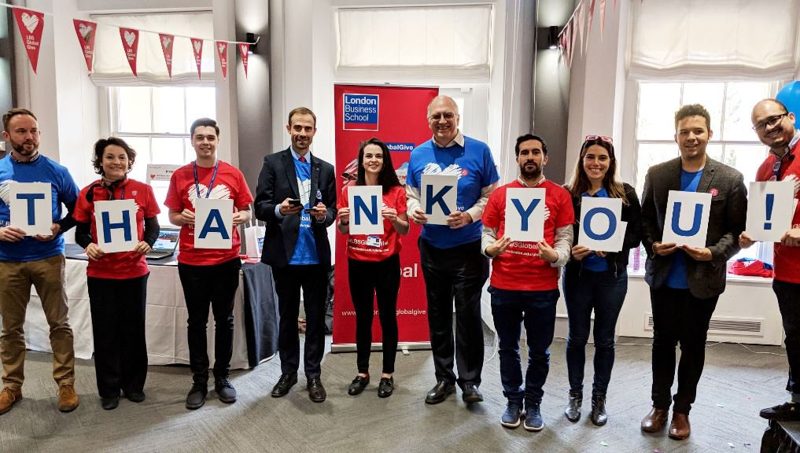
Ambassadors are volunteers who amplify your Giving Day by spreading the word through their own networks and lending the campaign the social proof that turns awareness into action. They can be a powerful multiplier, but only run a programme if you have both the staff capacity to support it and a genuine network of supporters willing to be active on your behalf. Recruit lead ambassadors early, give them clear assets and messages, and make their contribution visible through a leaderboard so the most engaged are recognised. London Business School, with alumni around the world, treat their ambassadors as a way to show how global their community really is. The right approach for you depends on who your advocates are and where they sit.
The day itself
By the time the day arrives, the strategy is set and your job is execution. Send your emails and social posts exactly as planned, watch the social conversation and join it, track your challenge progress and adjust your messaging as the picture changes, and, if you are running them, let your on-campus events feed the digital push. Make giving possible at every touchpoint, including a prominent donate button on every page and, for in-person moments, a QR code that takes people straight to your donation page. You can create one in seconds with the free QR code generator. Answer questions and unsubscribe requests promptly, keep an eye on deliverability, and hold your nerve: the campaign you spent six months planning now runs largely on the rails you built for it.
Stewardship: the day after and the year after
What you do once the day ends determines whether you have gained a one-off spike or a lasting relationship. Within a week, send donors a results email with the totals, the success stories and a clear reminder of the impact they created. Then keep going. Monthly impact updates, ideally exclusive to donors rather than buried in a general newsletter, use stories and visuals to show supporters that their gift is still at work. This is also where next year's Giving Day quietly begins, because the donors you steward well are the ones who give again, and some of them, as Highgate found, become the match donors who make the next campaign bigger.
Reviewing and improving
Treat every Giving Day as the foundation for the next. Capture the metrics that matter: donor count and total income, your average and most common gift, and a breakdown of gifts by channel, segment, country, age, graduation year and fund, alongside your email open, click-through, unsubscribe and conversion rates and your social reach and sentiment. Bring the team together afterwards to celebrate the wins, talk honestly about what was hard, and agree what you will change. Share the full results internally with leadership and teams, and the top-line story externally with the donors and supporters who made it happen.
A Giving Day is hard work, but it is some of the most rewarding work a fundraising team can do. As Balcarras's headteacher says to any state school weighing one up, the advice from those who have done it tends to be refreshingly simple: "Do it!"
Frequently asked questions
How long should a Giving Day last? Most run for 24 or 36 hours. A 36-hour window from 8am on day one to 8pm on day two gives you two morning peaks and two evening peaks to work with, which suits a fuller email schedule. Shorter 24-hour days create more urgency but leave less room for recovery if a quiet patch hits.
How far ahead should we start planning? Around six months for a first Giving Day. Experienced teams running an annual day can work to a shorter cycle, but the strategic decisions, match-donor conversations and content gathering all benefit from lead time.
How much match funding do we need? As a guide, aim for roughly half of your target in match and challenge funds. If you want to raise £100,000, look to secure around £50,000. More match funding, used through well-timed challenges, generally means more participation.
Do we need a big team? No. Small teams run successful Giving Days by focusing on the two things that matter most, email communications and match funding, and by borrowing capacity from alumni relations, marketing and student services for the rest.
What matters most on the day? Sending your planned communications on time. The data is consistent: the large majority of gifts arrive within about 90 minutes of a message going out, so a disciplined schedule is the difference between a steady stream of gifts and a quiet day.
Members' resource pack
Sign in with your email to unlock these editable templates:
- Giving Day project plan template
- Giving Day communications plan template
- Giving Day email copy templates
- Case for support template
Tools
- Hubbub's Giving Day Simulator: model your likely result before you commit to a target
- Fundraising Copy Checker: sharpen your emails and appeal copy
- QR Code Generator: link in-person moments straight to your donation page
Further reading
- Hubbub's Giving Day platform and expert support
- Hubbub's how-to guides: email fundraising, match and challenge, ambassadors and social
- Hubbub's digital fundraising webinars
- Giving Day case studies: Balcarras School, Highgate School, Royal Hospital School and London Business School
- Sector bodies: CASE and IDPE
See the full links directory for more.